|
|
 Dropping the ball in Times Square is the world's most well known New Year's Eve celebration. Nearly one million people attend in person with millions around the world watching the televised event. The millennium celebration saw two million people - I was one of them. The photo was taken on Sunday afternoon and preparations were already underway - television crews were setting up. (Note: click on the photo to enlarge it - if you look carefully, you can see the 2008 sign and pole for the ball above it.) The ball drop has been an annual event since 1907, making this year the 100th anniversary. The ball itself has gone through numerous incarnations over the last one hundred years. It's earliest construction was of iron and wood with 25 watt bulbs - weighing 700 lbs. In 1920 it was replaced with a ball entirely of iron (400 lbs) and then in 1955 with an aluminum ball weighing only 150 lbs. It remained unchanged until the 1980s, when red light bulbs and a green stem converted the Ball into an apple for the "I Love New York" marketing campaign (from 1981 to 1988). In 1989, the traditional Ball with white light bulbs reappears. In 1995, the Ball gets an aluminum skin, rhinestones, strobe lights, and computerized controls. The aluminum ball was lowered for the last time in 1998, when it is replaced by a all new geodesic design from Waterford Crystal with the latest lighting technology for the millennium celebration - 504 crystal triangles, 696 lights including 96 strobes, 90 rotating pyramids. Read more about this remarkable, dazzling creation and the event here. This ball has been retired and is the property of the owners the One Times Square building. An entirely new ball has been crafted for this year's 100th anniversary by Waterford Crystal with 672 double cut crystal triangles. An all new lighting design was created by Focus Lighting utilizing Philips LED technology (replacing the halogen bulbs of the previous design). With 9,576 Philips Luxeon LEDs, it is more than twice as bright with enhanced color capabilities - 16.7 million to be exact. The ball was unveiled in October and on display at Macy's until December 10th - sorry I missed it. Had it not been for researching this article, I would have been completely unaware of the anniversary and new ball - I look forward to watching the televised drop and hope you do the same. Happy New Year! Note: Time Balls actually date back to 1829, when the first one was erected in England by its inventor Robert Wauchope, a Captain in the Royal Navy. These were used for sailors to check their chronometers. They became obsolete with the advent of radio time signals. Over sixty still remain worldwide.
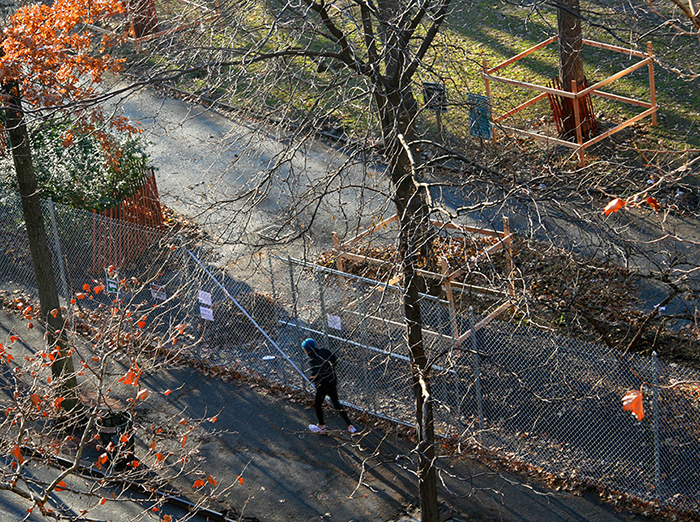 I joke around about my fascination with prison documentaries, typically entitled something like Lockdown which are presented with great drama. The drama here in the Village is at least as great with a war that has gone on for some time between community activists and the Parks Department and their plan to completely redo Washington Square Park, with activists preferring a rehab versus wholesale reconstruction. All agree the park is in serious need of repair - the last renovation was done in 1967. The details of this battle (which is a replay of previous ones in this activist community) and its raison d'etre has been told blow by blow from the local papers all the way to the New York Times. My previous posting from May gives an overview of the various issues at hand with links and more photos - click here. Lawsuits have been brought against the City of New York (the last of which the city won) and on the week of December 10th, workers moved in, fenced off over half of the park and began construction (which will be done in two phases in an estimated 2-3 years). Phase 1 is larger and includes the fountain area and plaza around it, where most gatherings and activities take place. In the warmer weather it will be interesting to see how the regulars and visitors adapt to the very limited space. I am a regular user of the park, long-time community resident and have been involved as a close observer of this process. I understand the viewpoints of both sides in this debate and I think it is important to remember that although opponents see the new design as radical, it will still remain a public park with a very similar layout. A radical proposition would have been the construction of high-rise condominiums in the Park's place. The battle between opposing sides has appeared large but I do not think most residents have really studied or weighed in on this situation at all, leaving the decisions to the powers that be. The number of voices on both sides are actually quite small when viewed in the context of a community with an estimated population of 150-200,00 people. There are aspects of the new design which some feel will substantially change the character of the park, such as a 4-foot high perimeter fence (to secure it at night). It will be interesting to see if the character or mood of the park, its activities and users changes significantly once the project is completed. Architecture alone does not define a place and New Yorkers are adaptable, resilient and strong willed. My prediction in the outcome of this card game is that the character of the neighborhood and will of the users easily trumps the design ...
 There are neighborhood restaurants that seem to have been around forever, yet rarely mentioned and infrequently reviewed. They exist quietly like the Tiro A Segno New York Rifle Club that fascinated me for decades ( click here for story). Or the missionary union in Manhattan that has not had one article written about yet - when I catch a friar on camera entering or leaving - you'll be the first to see it. Rocco Ristorante at 181 Thompson Street is a vintage home-style Italian restaurant founded by Rocco Stanziano in 1922 - 85 years must mean something. I have not eaten there yet, but the reviews are quite favorable, even from newer online sites such as yelp.com. It's just not glamorous, trendy or chic. Old, historic business establishments go down different roads. Some maintain quality, but raise prices substantially as they become real legacy businesses. Others just sell out and become money machines without any regard for quality (frequently cutting costs by outsourcing) - sometimes entire towns become tourist traps with businesses like this, such as Boothbay Harbor, Maine. Some catch a trend and reinvent themselves like Astor Place Haircutters - click here. And then there are those places that are sleepy backwaters, just doing things the same way, patronized by customers who like it exactly the way it is. Slow and steady wins the race ...
 Honesty can be a good policy and honestly, after a stressful holiday weekend with all the preparations and travel, I did not have the energy this morning to do a posting. So I perused my photos with disappointment and tried to figure out how to spin straw into gold, or at least silver. The photos of the window display of Disrespectacles Eyewear at 82 Christopher Street was always interesting to me but had been previously nixed as not worthy. But in doing an online search for this store, interesting things popped up. Like using the singular Disrespectacle returned only 5 items from Google, while the plural returned 2450 - quite unusual. Typically, the singular brings back more than the plural (?). I also found a website on lovewords that defined Disrespectacle as: "To be publicly disrespected." Finally, I arrived at the store's website - you can link to it here. I found descriptions of their product line like funky, trend-setting, hip, über-sleek, industrial-sleek, high fashion, hard-to-find, and ultra high-end boutique, with features and reviews from all the top fashion publications. Retailing is very competitive - merchants must be increasingly creative to stay alive in a crowded marketplace. And they are protective of their efforts. I am more and more frequently told I can not take photographs in stores - in some cases (like restaurants) this is to protect the privacy of patrons, but often it is due to paranoia - i.e. that others will steal their ideas for displays and decor. All the newer, trendy establishments which are hyper-designed are like this. Pinkberry (a new frozen dessert place) is a good example - they have a no photography icon on their windows. In shooting from the street through the windows at the French restaurant Balthazar in SoHo, I had a waiter inside waving his arms at me to signal that no photos are to be taken. So, from time to time, when I can manage to take a photo surreptitiously, I will offer you über-peeks of the verboten...
 Can you have too much Macy's? - perhaps. But regular readers of this website know that I do bemoan the disappearance of so many NYC places and things that have given New York the character it is known for. As I also have written in my recent post Constant, many of the feelings that the best things and times have past are nostaligic and a complaint of every generation. Championing a merchant may appear to be unnecessary - they do get paid already as a business. And I have complained about excess consumption in this country with an over emphasis on materialism. However, we do need merchants and Macy's is not an ordinary merchant. To lose them would be sad. Their sponsorship and historic relationship with the Thanksgiving Day Parade (over 80 years) and the July 4 th fireworks set them apart. They are part of the physical and psychic fabric of the city. I have written about them in more detail - click here for last year's posting. There is a security in knowing they are there, particularly as the world becomes more temporal, fragile and mutable. We need anchors. It reminds me of a Woody Allen comment about why he needs to live in NYC - that there's a restaurant in Chinatown where he can get a certain favorite dish at four o'clock in the morning. Not that he every has or will go there at that time. It's just knowing it's there. Macy's is one of those places - that whether you go patronize them or not, for a New Yorker, it's important to know they are there, especially at Christmas ... Posting Note: This posting will remain for two days (Monday and Tuesday) - I will be away with my family in New England. New postings will resume Wednesday. Happy Holidays.
 The problem with Bleecker Street is nothing new - a place being a victim of its own success. Over time, the South Village has gone through several incarnations. In the early 19th century, the area around Minetta Street became known as Little Africa. A large portion of the city's black population was living within a few blocks of Minetta Street - these were freed African-Americans (New York State abolished slavery in 1827). The area saw the nation's first black church, the first black theater ( African Grove) and the first black newspaper ( Freedom Journal). By the 1850s, the area just slightly east, where the Washington Square Village apartment complex now stands, became settled with an immigrant French community - in fact the area was known as Frenchtown. By the 1870s, most of the French had moved uptown, tourists invaded and the area became commercialized. Known as the Latin Quarter, it was populated with brothels and taverns. Later of course, from the early 20th century through the 1950s and 60s, the area became a renowned bohemian enter and still has that reputation to this day. Where does that leave us? Well, it leaves me with very mixed feelings about a street that has had quite a run and been virtually synonymous with Greenwich Village. The few blocks just between 6th Avenue and Laguardia Place has had many landmark establishments - The Village Gate, Bleecker Street Cinema, The Back Fence, Kenny's Castaways, Terra Blues, The Little Red Schoolhouse, Le Figaro Cafe, The Bitter End, Peculier Pub, Cafe Au Go Go and the Actor's Studio Drama School. In fairness, I must say that there are still many quality business establishments on the street, like Terra Blues e.g. When a place has been beaten hard with an onslaught of tourists for over a century, you do the best you can. And on a quiet weeknight with a little drizzle in the air and the soft neon glow of the Back Fence's neon signs, things don't look all that bad ... A note about the street name: Bleecker Street is named for Anthony Bleecker (1770–1827), a poet and friend of Washington Irving and William Cullen Bryant. The street ran through his farm and in 1807, Bleecker and his wife deeded the land to the city.
 It is amazing how inured we can become of things with constant exposure - like a beautiful vista seen daily. If someone had asked the existence or whereabouts of a nativity scene in NYC, I'm not sure if I would remembered this one, yet it is essentially a city block long on one of the busiest streets in Manhattan - Houston Street, a veritable crosstown highway, the dividing line between the Village and SoHo. It is not a street typically used by pedestrians for strolling - although there are retailers (like Rafetto's), the street does not have the ambiance of the surrounding smaller streets.Not to mention I cross this street daily and have done eight postings on subjects found on it. The photo shows the life size nativity which is erected annually by St. Anthony's church - officially the Church of St. Anthony of Padua at 154 Sullivan Street. The Roman Catholic Shrine church was built in 1866. It is staffed by the Franciscan Friars and is the oldest existing parish founded for ministry to Italian immigrants in the United States. In the 1930s, Houston Street was widened for the construction of the subway. Tenement buildings on abutting the north side of the church were demolished, leaving a narrow space between the church's north wall and Houston Street, where the Nativity scene is installed. Interesting note: Convicted Mafia mobster, Vincent "The Chin" Gigante, was a habitue of Greenwich Village. He died December 19, 2005 - his funeral was held at St. Anthony's church.
|
|


 2 ... 2 ...
 Dropping the ball in Times Square is the world's most well known New Year's Eve celebration. Nearly one million people attend in person with millions around the world watching the televised event. The millennium celebration saw two million people - I was one of them. The photo was taken on Sunday afternoon and preparations were already underway - television crews were setting up. (Note: click on the photo to enlarge it - if you look carefully, you can see the 2008 sign and pole for the ball above it.)


